Description
The purpose of this project is to implement the sort-merge join and hash-join algorithms for a relational
database management system (RDBMS). You will simulate the algorithms based on the given
configurations, i.e., database file size, block size, the number of available memory blocks, etc.
GETTING STARTED
You should at least implement the following three classes:
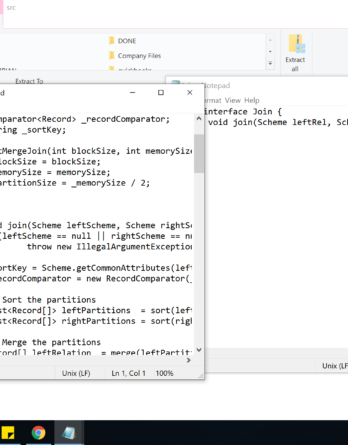
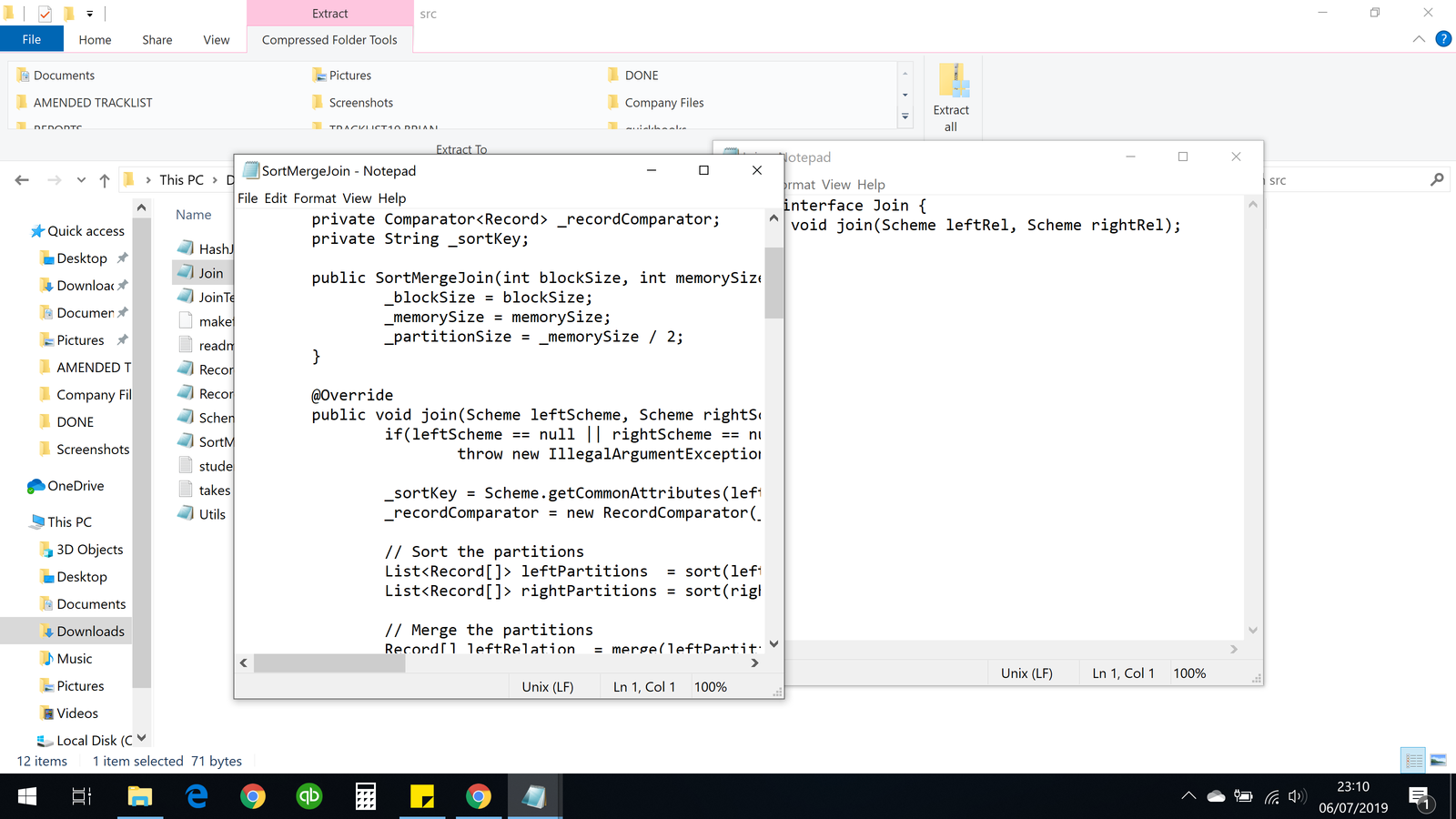
sortMergeJoin class which implements the sort-merge join algorithm. You need to implement at
least three methods in this class:
o sort method which takes an unsorted database file as input, divides the file into a number of
partitions, and sorts each partition in memory (You can use Java build-in sort() method
directly). Remember that a partition is a list of blocks, and a block stores a list of database
records. In other words, you should implement a partition as a two-dimensional array. This
method should output the sorted partitions to files.
o merge method which takes the sorted partitions as input, and merge-sorts them into a
completely sorted list. You must implement this method by following the algorithm
introduced in class. You CANNOT use Java build-in sort() method to implement this
method. This method should output the completely sorted list to a file.
o join method which takes two sorted database files as input and joins these two files together
to implement the natural join operator. The final joining result should be written to an output
file.
hashJoin class which implements the hash join algorithm. You need to implement at least two
methods in this class:
o hash method which takes an unsorted database file as input, uses a hash function to hash the
data records into a number of buckets, and outputs these buckets to files.
o join method which takes two buckets (one from the build relation, the other from the probe
relation) as input, uses the build relation to build an in-memory hash table, and joins the
probe relation with the build relation. The final joining result should be written to an output
file.
joinTester class which holds your main method.
Your program will take two command line arguments:
% java joinTester block_size memory_size
The first argument block_size determines the capacity of a block, i.e., the number of records can be
stored in one block. The second argument memory_size determines the number of available memory
blocks. The two database files student.txt (244 records) and takes.txt (3694 records) can be
downloaded from Canvas. The schemas of these two files are:
Student (ID, name, dept_name, credits)
Takes (ID, course_id, sec_id, semester, year, grade)
Your program should generate the following output files:
1) Sorted student and takes partitions generated from sortMergeJoin.sort() method. Note:
use one file to store one partition, and name the file as smj_student_i.txt and
smj_takes_i.txt (here i is the index of the partition).
2) Two completely sorted database files generated from sortMergeJoin.merge() method. Name
them as sorted_student.txt and sorted_takes.txt, respectively.
3) The joining result generated from sortMergeJoin.join() method. Name the file as smj.txt.
4) Hashed student and takes buckets generated from hashJoin.hash()method. Note: use one
file to store one bucket, and name the files as hj_student_i.txt and hj_takes_i.txt (here
i is the index of the bucket).
5) The joining result generated from hashJoin.join() method. Name the file as hj.txt.
One last note: Remember that you are simulating two joining algorithms for an RDBMS, and the smallest
unit of operation in an RDBMS is block. Therefore, all of your operations should be block-based. For
example, when you read in a sorted partition into memory to implement sortMergeJoin.join()
method, you can only read in one block of data from that partition, because we assume the memory is
constrained by a limited number of available blocks.
SUBMISSION
You need to submit a single zip file as your solution via the Canvas system. In this zip file, you need to
include:
All the java source files you have created.
A readme file which includes all the information you would like to share with the instructor
and/or the grader. If there’s nothing to share, this file can be omitted.
GRADING
(10 points) Compilable program files
(40 points) Program Correctness