Description
Introduction
This assignment asks you to attach tree building actions to the rules of the Cb grammar so that an
abstract syntax tree (AST) is created for any Cb program.
Two AST visitor classes, implemented using the Visitor design pattern, are to be included in the cbc
program. One visitor constructs a top-level dictionary structure containing some details for
namespaces and classes. The other visitor prints the entire contents of the AST and the code for this
visitor is provided as an example.
Assignment Description
The introduction said it all. The AST must be implemented using the classes and node tags which
have been provided in the CbAST.cs file (see below).
You may want to adjust the grammar rules in order to simplify the task of building the AST. This is
permitted provided that the language accepted by the parser is not impacted. Your parser can accept
a superset of the Cb language described in the Cb specification as long as the additional features are
also accepted by the C# compiler.
Building the AST
The AST-DataStructure document explains the AST structure in some detail. The names used
for node tags correspond very closely to names of non-terminal symbols in the grammar.
A few semantic actions for creating AST nodes are provided in the CbParser.y file and can be
used as examples to imitate. (Creating a k-ary node is not obvious, so it’s best to just imitate the provided examples.)
You will need to add semantic actions to the ends of (nearly all) the production rules in the grammar,
and these actions will construct new nodes, and pass references to nodes to constructors, as necessary.
Note that every AST node is supposed to contain the corresponding line number in the source code.
When a construct (say a while loop) spans two or more lines, we probably want to associate the starting line number with the node for that construct rather than the ending line number. However if we
look up the current line number when we allocate the AST node, we will usually be looking it up
when the parser has reached the end of the construct. (The exception is for k-ary nodes which are
normally allocated at the start of a construct.) A better line number can be obtained by copying it
from the first subtree of this new node – examples of this can be seen in the supplied code.
Building the TopLevel Namespace Dictonary
You will need to program a new subclass of Visitor. (See CbPrVisitor.cs for an example.) The
visitor methods have an extra parameter of type object which can be used to pass information around
during the traversal. If you do not need to use this parameter, just pass null as the value rather than
create new Visit and Accept methods.
When invoked from the code in the cbc.cs file, this visitor will traverse the AST and perform the
following actions:
• If it encounters a “using System” declararation, it must copy all classes in the System
namespace (this is Cb’s stripped down version of System, not the real C# one) to the top level,
so that a method invocation such as
Console.WriteLine(“Hello”);
can be used in addition to the long-winded but correct
System.Console.WriteLine(“Hello”);
I.e., the type description of the Console class (and a few other classes) must be copied from the
System namespace to the top-level namespace.
• If it encounters a declaration of a class, a type descriptor for that class (see the CbType.cs file)
must be created and added to the top-level namespace.
• If it encounters declarations of members of a class (these can be constants, fields, and methods),
it must create an appropriate descriptor for that member and add it to the class’s type descriptor.
• The only semantic checking that need be performed during the traversal concerns checking for
duplicate declarations of names. In Cb, we cannot declare two classes with the same name and a
class cannot contain two members with the same name.
The AddMember methods of the NameSpace and CbClass types return a result to indicate
whether the name was a duplicate. If a duplicate is found, an error message with an appropriate
line number should be generated.
The Provided Materials
• You are provided with everything needed to start this assignment. If you wish, you may discard
your solution to Assignment 1 and start over with the files provided on the conneX website.
Alternatively, you may choose to keep working with your original files (and copy corrections and
improvements from the supplied files into your own code).
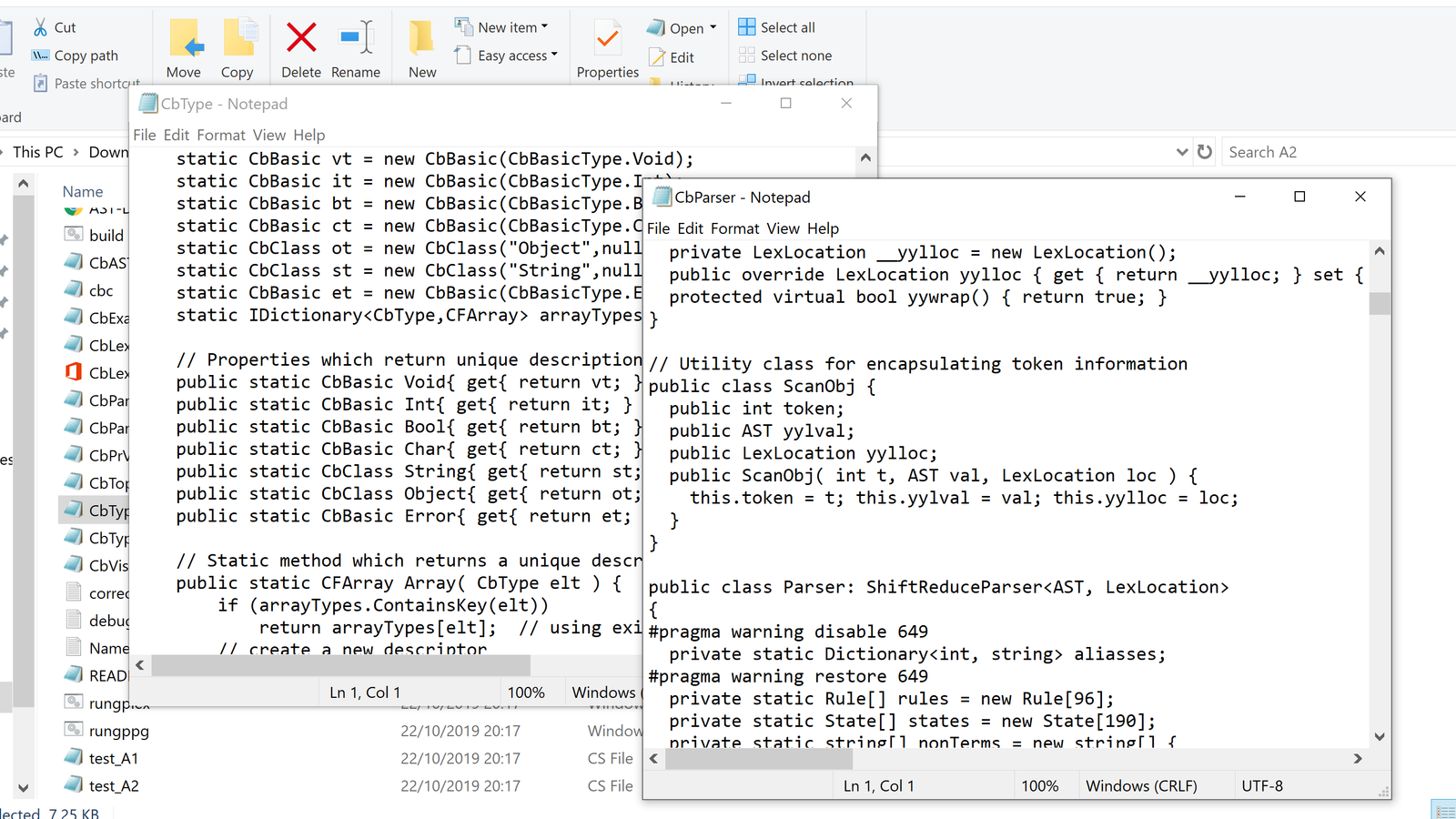
• The supplied source code files are listed in the table below.
File Description
cbc.cs The main program which invokes everything else.
CbLexer.lex The lexical specification file to be processed by gplex
CbParser.y The grammar file to be processed by gppg
CbAST.c The classes used for building the AST
CbVisitor.cs The parent class for the Visitor pattern
CbPrVisitor.cs A visitor for printing the AST
CbType.cs Classes used for describing Cb datatypes
CbTopLevel.cs Classes used for contents of Cb namespaces
AST-DataStructure.pdf Explanation of the AST structure
• For Windows users, three batch command files are provided:
Linux or Mac OS X users can copy the commands into a Makefile or into shell scripts.
Submission Requirements
1. You must provide exactly one file. It must be a zip file or gzipped tar file which contains the
source code files cbc.cs CbLexer.lex CbParser.y CbAST.c CbVisitor.cs
CbPrVisitor.cs CbType.cs CbTopLevel.cs.
If you added more C# files to your project, include those too.
2. Also include a file named README.txt which identifies the team members. If you have any
comments you want to share about problems with the assignment, this is an appropriate place to
supply the comments.
3. Important: do not include any files generated by gplex or gppg in your submission. (You of
course must not edit the C# code output by these two tools.)
4. Again, the project is to be completed in teams of either 2 (or possibly 3) persons. The ideal size is
2 people. The teams do not have to contain the same members as for Assignment 1.
rungplex.bat Runs gplex on CbLexer.lex
rungppg.bat Runs gppg on CbParser.y
build.bat Builds cbc.exe from all the C# source files